

How Modular Units become MTP-capable: A precise cut makes all the difference
Why reusability, integration and competitiveness in machine and skid construction are decided earlier than many expect.
Modular process equipment assemblies (PEAs) are considered key to scaling and efficiency.
In reality, however, reusability rarely fails due to technology, but rather due to unclear PEA cuts and a lack of structure.
This white paper shows how a clearly defined PEA cut
creates the basis for reusable, integrable and competitive PEAs.
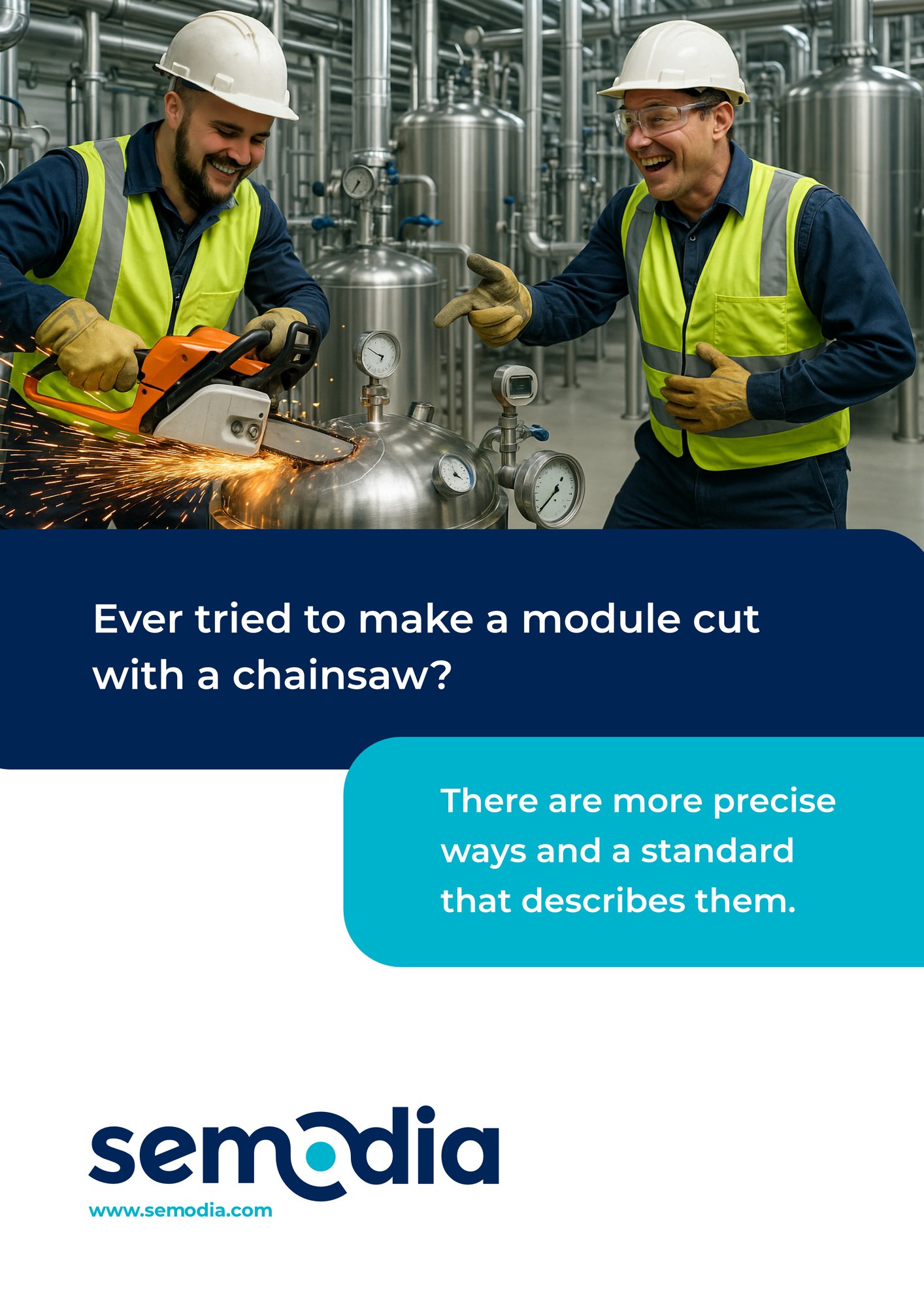
Why modularisation often fails to scale in everyday life
Many machine and skid builders develop modular units
that are technically similar but still need to be redesigned for each project.
Typical symptoms are:
- similar PEAs, but no real reuse
- growing integration effort on the part of the operator
- project-specific variants instead of scalable products
- knowledge that is only stored in individual minds.
The cause often lies not in engineering, but in early structural decisions that were never consciously made, especially when it came to module design.
The module cut is not a detail but an architectural decision.
The module cut of a Process Equipment Assembly (PEA) defines:
- which functions belong to the unit
- where clear boundaries lie
- how the unit interacts with the outside world (services, signals, operation).
It thus determines at an early stage:
- whether modular units remain reusable
- how much integration effort is required on the part of the operator
- how scalable plant and procut concepts will be.
The white paper shows why this decision is neither ‘too early’ nor purely technical, but has a strategic impact.
What you can expect in this white paper
- What constitutes a viable PEA module section
- Why reusability is more than just similarity
- What role semantics plays in scalable modularisation
- How integration costs can be specifically reduced for the operator
- Typical errors in thinking during the first MTP project and how to avoid them
Who this white paper is intended for
This white paper is addressed to:
- Managing directors and technical decision-makers in mechanical and plant engineering
- Those responsible for engineering, architecture and digitalisation
- Manufacturers of skids and modular process plants
- Companies that want to approach modularisation strategically rather than experimentally
It is not intended as:
- A tool comparison
- Basic MTP training
- A marketing brochure

Would you like to learn more about getting started with your modular unit or the MTP?
MTP as an enabler rather than an end in itself
The Module Type Package (MTP) provides a standardised framework for making modular units describable and integrable.
However, MTP only takes effect if the structure, module interface and meaning are clearly defined.
The white paper therefore deliberately classifies MTP as an enabler for reusability and integration rather than as a solution for unresolved architectural issues.
Why this white paper?
In our day-to-day project work, we are constantly faced with the question of how to get started with modularisation and MTP. With this white paper, we would like to provide an insight into which practices have proven successful so far. You can carry out the steps listed yourself and feel free to contact us if you have any questions. All information is based on practical experience:
- with machine and skid manufacturers,
- experience from MTP implementations and pilot projects,
- analysis of typical integration and scaling problems.
but on realistic decisions in everyday project work.
Frequently asked questions
Frequently asked questions
A PEA is a modular process engineering unit that performs clearly defined functions and can be integrated into different systems. It forms the basis for reusable and scalable process solutions in mechanical and plant engineering.
What does MTP capability mean for PEAs?
MTP capability refers to the ability of a PEA to be described in a standardised manner, integrated and operated.
Why does reusability often fail?
Not because of a lack of technology, but because of unclear module sections, a lack of differentiation and inconsistent models of meaning.
Who would particularly benefit from reading this white paper?
For companies that want to scale modularisation and avoid starting every project from scratch.